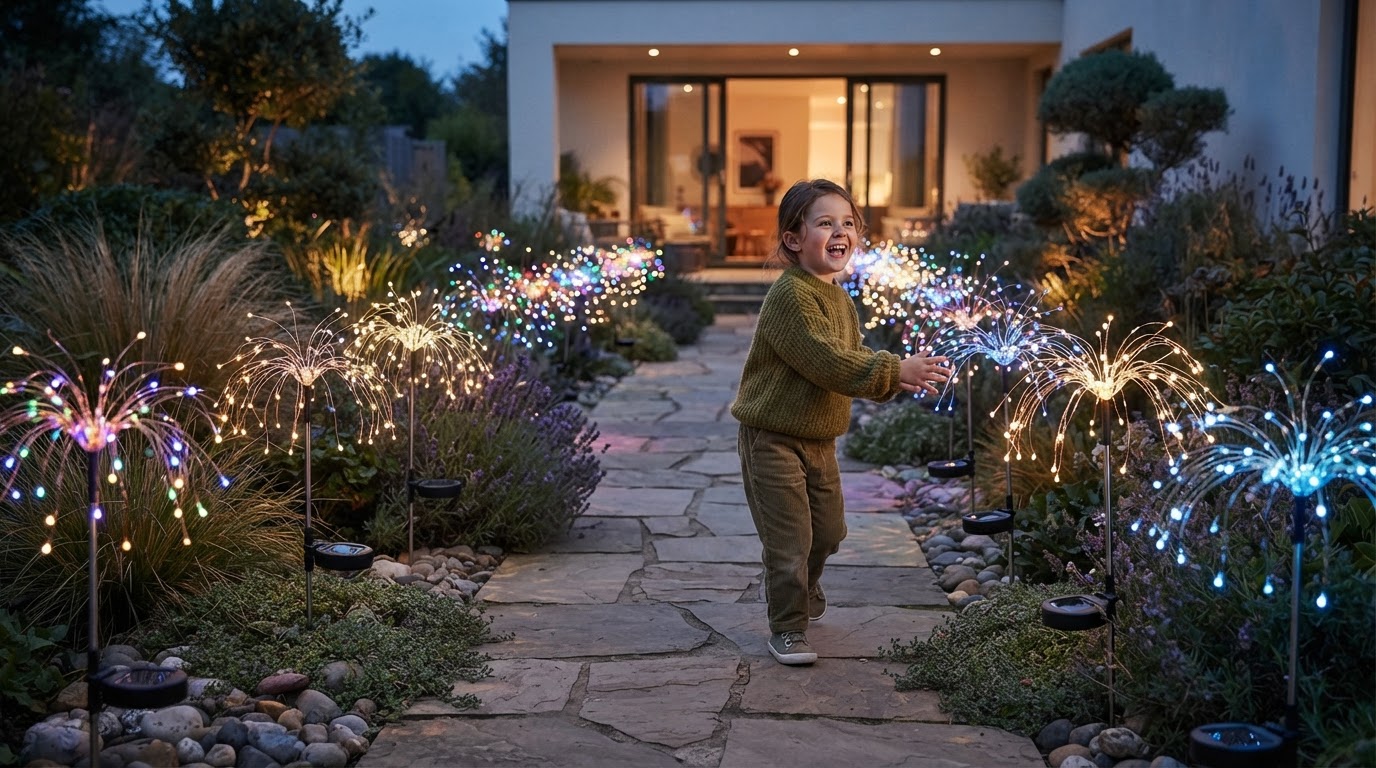
Designing Walkways with Solar Firework Light Installations
 Maya ChenContributing Editor
August 17, 2026. This technical overview examines the methodology for implementing high-density light displays using Solar Firework Light hardware. It is intended for homeowners seeking to move beyond standard stake lighting toward architectural-grade DIY installations.
The Limitations of Conventional Pathway Illumination
The conventional wisdom says that pathway safety requires uniform, low-intensity pools of light spaced at six-foot intervals. However, this approach often results in a visual "runway" effect that lacks depth and fails to highlight the vertical dimension of the garden. Most DIY solar landscape lighting ideas fall into the trap of prioritizing utility over aesthetic composition, leading to a sterile environment that disappears after dusk. Modern yard design demands more than just visibility; it requires a focal point that maintains interest through varying weather conditions. According to recent search trends for waterproof solar outdoor decoration for yard, consumers are increasingly moving away from the flat profile of traditional lanterns in favor of three-dimensional structures. The problem with standard solar stakes is their rigid light distribution, which cannot be adjusted to mimic natural textures or botanical shapes. This rigidity forces a linear design that often clashes with the organic curves of a well-maintained garden bed.
Technical Integration of Solar Firework Light Hardware

Photo by Laura Manzi on Pexels
Solar Firework Light addresses the limitations of static fixtures by utilizing flexible copper wiring and high-efficiency LED garden stakes. Unlike the fixed-reflector designs found in most solar path lights decorative, these units allow for manual shaping of the light output. Each light consists of multiple micro-LEDs distributed along pliable wires, enabling the user to mimic the radial symmetry of an allium flower or the weeping structure of a willow. Run the math: a single firework light provides significantly more points of illumination than a standard plastic path light, which typically relies on a single LED bulb and a cheap plastic diffuser. This density is critical when executing diy solar landscape lighting ideas that require a sense of volume. The hardware is specifically engineered to function as a waterproof solar outdoor decoration for yard, ensuring that the internal circuitry remains shielded during heavy precipitation. By staggering these units at varying heights, you create a layered lighting effect that traditional solar path lights decorative simply cannot replicate. The high-capacity solar panels integrated into each stake are calibrated to capture ambient light even in partial shade, though direct sunlight remains the optimal energy source for maximum runtime.
Design Framework for DIY Pathway Installations

Photo by John Davis on Pexels
When planning a DIY installation, the objective is to balance the whimsical nature of firework lights with the structural requirements of a safe walkway. Here's the part nobody talks about: over-saturation of light can be just as detrimental as under-lighting. To avoid visual clutter, follow this deployment framework:
- Spatial Density: Place units in clusters of three or five rather than a single file line to create "islands" of light.
- Wire Shaping: Curve the copper wires outward and slightly downward to prevent glare and focus the light on the path surface.
- Height Variation: Vary the depth to which the stakes are driven into the ground to create a multi-tiered horizon line.
- Color Temperature Sync: Ensure all units utilize the same Kelvin rating to maintain visual cohesion across the landscape.
- Panel Orientation: Angle the solar receptors toward the southern sky, clear of low-lying foliage that may grow over the sensors.
Shop Solar Firework Light here.