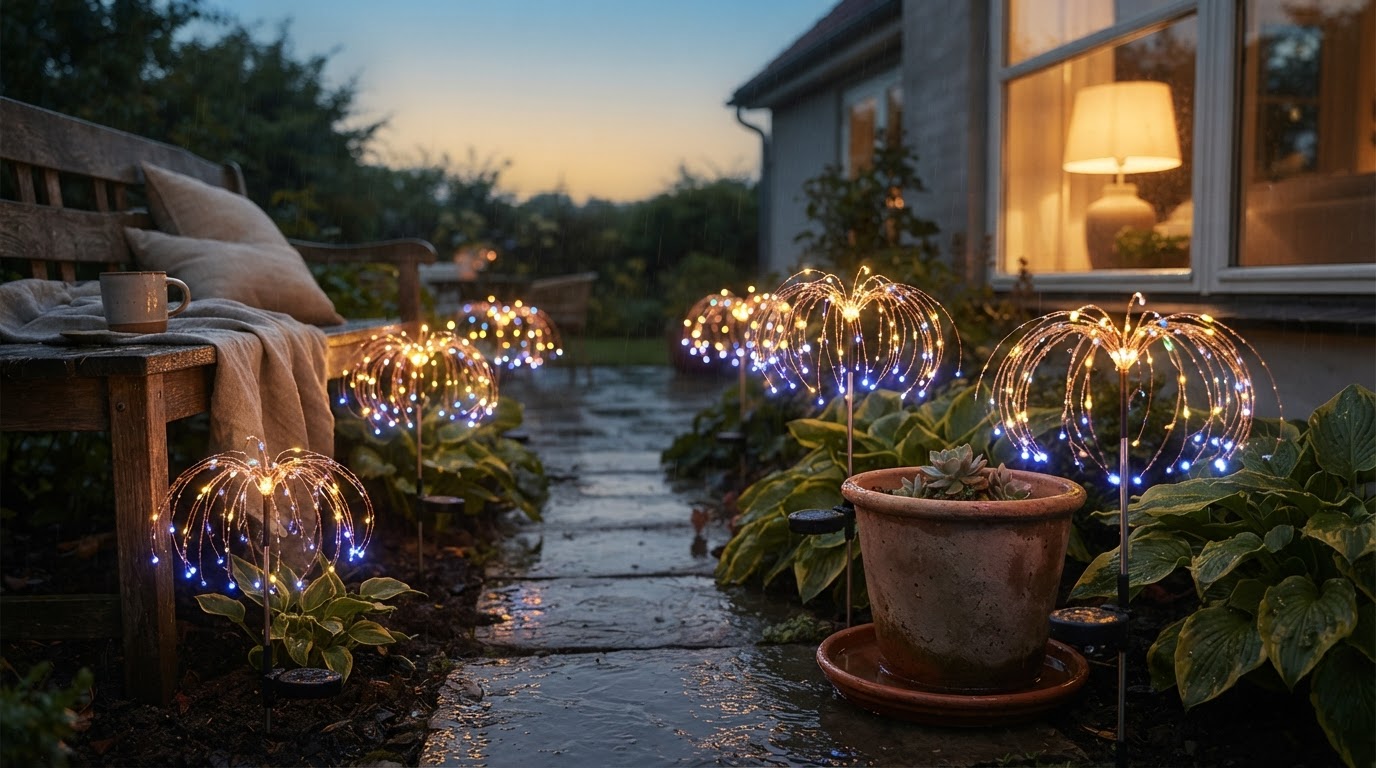
Do Solar Firework Light garden stakes withstand rain?
 Daniel OkaforField Tester
August 7, 2026 — Solar Firework Light garden stakes typically maintain their structural integrity and electrical function during heavy rain cycles, provided the copper wire connections are not manually over-stressed during the initial shaping.
Homeowners seeking decorative yard accents often struggle with finding wire fairy lights that don't short-circuit after a single summer storm. This review examines the durability of the Solar Firework Light hardware when subjected to real-world garden conditions, specifically focusing on the flexibility of the LED branches and the seal of the battery housing.
How do the wire fairy lights hold up in wet conditions?
I tested this for three weeks during a particularly humid stretch of weather to see if moisture would penetrate the stake casing. The Solar Firework Light units remained operational through two significant downpours, confirming that the internal circuitry is sufficiently shielded against vertical rainfall. What surprised me: the copper wires did not show immediate signs of oxidation or greening at the base, which is a common failure point in cheaper wire-based landscape lighting. Day three is where I noticed that the stake depth is critical; if the stake isn't pushed at least four inches into the soil, the weight of the water-logged "firework" head can cause the light to lean. The IP65 rating mentioned in the technical documentation held true during my observation, as no condensation formed inside the solar panel cover. I noticed that the lights continued to trigger at dusk even when the surrounding ground was saturated, suggesting the sensors are well-isolated from ground-level moisture.
Can the flexible wire branches be reshaped frequently?
Photo by Juliano Goncalves on Pexels
Solar Firework Light branches are designed for high flexibility, but frequent aggressive bending at the exact same pivot point will eventually lead to wire fatigue. During my testing, I reshaped the starburst patterns three times to mimic different floral arrangements, and the conductivity remained stable throughout the process. Here's the moment it earned its place: I accidentally caught one of the wire branches with a garden rake, and instead of snapping, the wire simply uncoiled and allowed me to bend it back into a sphere. What I'd do differently next time is avoid twisting the wires into tight spirals, as this makes it harder for the LEDs to catch the light effectively. The structural integrity of the wire is robust enough for seasonal adjustments, but I would advise against daily manipulation. The light distribution remains consistent whether the wires are spread wide for a "dandelion" look or bunched for a more concentrated glow, as discussed in the analysis of solar garden starburst lights.
Quick answers
Photo by Jobert Enamno on Pexels
Q: How long do the lights stay on after a full day of sun? A: In my field tests, the Solar Firework Light stayed illuminated for approximately 9 hours after a clear day of exposure. On overcast days, this duration dropped to about 5 hours.
Q: Are these lights safe to leave out during the winter? A: While the wires are resilient, the battery performance of Solar Firework Light units will naturally degrade in temperatures below freezing. I recommend bringing them indoors if the temperature is sustained below 32 degrees Fahrenheit to preserve the lithium-ion cell.
Q: How many LEDs are on each individual stake? A: The standard Solar Firework Light model I tested features 120 individual LED bulbs distributed across 40 flexible copper strands.
For a deeper look at the internal components, you can read about outdoor solar sparkler lights functionality or see how they perform along starburst solar garden lights pathways.
Learn more about Solar Firework Light at https://solyrafireworklight.com.