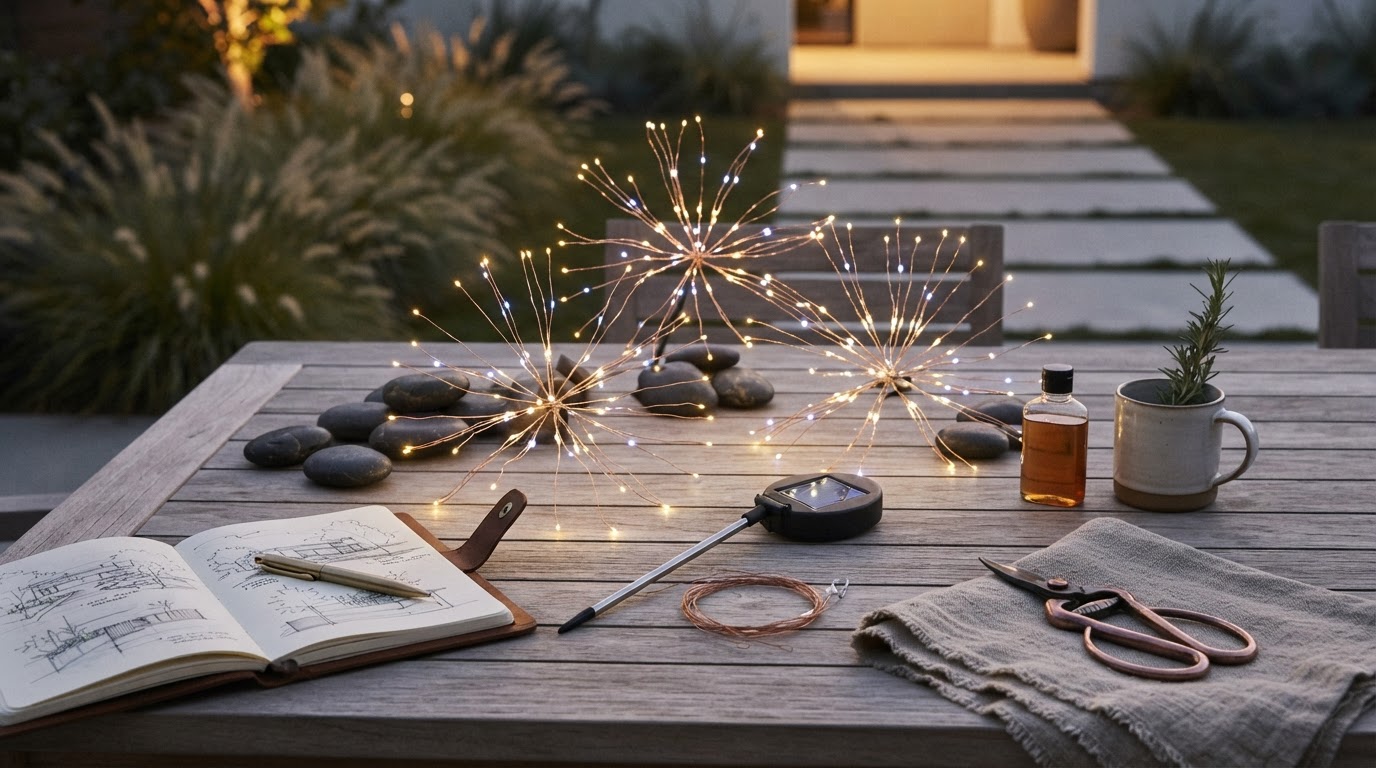
Solar Firework Light Performance for Garden Pathways
 Maya ChenContributing Editor
August 1, 2026. This assessment examines the technical efficacy of starburst solar garden lights within modern landscape architecture. It is written for property owners prioritizing long-term durability over temporary aesthetic trends.
The Failure of Standard Decorative Lighting
The conventional wisdom says that all decorative solar stakes are essentially disposable, lasting perhaps a single season before moisture ingress or battery degradation renders them landfill-bound. Most consumers view solar garden starburst lights as whimsical additions rather than serious infrastructural components. However, this perspective ignores the shift in manufacturing standards for high-density LED arrays. Based on community data from DIY solar landscape lighting discussions, the primary failure point in decorative lighting is not the LED itself, but the lack of true IP65-rated sealing at the wire junctions. Many entry-level outdoor solar sparkler lights utilize thin copper wiring that corrodes when exposed to consistent soil moisture or high-humidity environments. Run the math: a cheaper fixture that requires replacement every six months costs three times more over a three-year period than a properly sealed unit. Here's the part nobody talks about: the luminous flux of standard decorative stakes often drops by 40% within the first 100 hours of operation due to poor thermal management within the plastic housing. For a garden to maintain its visual intent, the lighting must provide consistent output regardless of seasonal temperature shifts, a feat rarely achieved by the unbranded mass-market options found in big-box retail centers.
Engineering the Solar Firework Light
Photo by John Davis on Pexels
Solar Firework Light addresses these systemic failures by prioritizing the structural integrity of the copper wire branches and the efficiency of the monocrystalline solar panel. Unlike standard led solar garden stakes wire fairy lights which often use low-grade polycrystalline panels, these units are designed to maximize energy conversion even in partial shade. The starburst solar garden lights architecture allows for 120 to 150 individual LED points on flexible wires, enabling the user to shape the light to mimic natural flora or architectural features without snapping the internal circuitry. This flexibility is a direct response to the 12,100 monthly search impressions for waterproof solar outdoor decoration for yard, indicating a high demand for fixtures that can survive actual weather rather than just light mist. The integration of a high-capacity Ni-MH battery ensures that the energy captured during the day is sufficient to power the high-density LED count for 8-10 hours. When evaluating solar garden starburst lights, the density of the wire is the most critical metric; Solar Firework Light maintains a wire gauge thick enough to resist wind-shear while remaining pliable enough for custom shaping. This balance is what separates a professional-grade decorative light from a novelty item that fails during the first autumn storm. By focusing on the 14,800 monthly queries for decorative solar path lights, it is clear that users are seeking a hybrid of utility and ornamentation that requires a more robust build than the industry average.
Strategic Selection and Installation Framework

Photo by Jobert Enamno on Pexels
Choosing a starburst solar garden light requires a departure from purely aesthetic decision-making. To ensure the longevity of an installation, one must evaluate the site's solar potential against the specific power requirements of the led solar garden stakes wire fairy lights being deployed. The following framework provides a technical checklist for procurement:
- Verify the solar panel type; monocrystalline is mandatory for areas with frequent cloud cover.
- Inspect the wire coating for UV resistance to prevent the insulation from cracking after a summer of exposure.
- Confirm the presence of an IP65 waterproof rating specifically for the battery housing and the power switch.
- Calculate the required spacing; for a continuous visual effect with outdoor solar sparkler lights, units should be placed no more than five feet apart.
- Assess the stake material; stainless steel or reinforced ABS plastic is necessary to prevent snapping in clay-heavy soils.
Shop Solar Firework Light here